The Pilgrims come to America in 1620, the Pilgrims sailed on
the Mayflower to America. They were warned that Indians may attack them. The
voyage could be dangerous. There could be pirates or hurricanes. The Pilgrims
risked their lives.
It all started with a king. The King of England said that everyone must belong to his church. The Pilgrims wanted to pray in their own church. They tried to meet in secret but the king had the Pilgrim leaders arrested. The Pilgrims decided to leave England. They sailed on the Mayflower to find religious freedom. They gave up their houses. They said good-bye to their friends.
The ship was very crowded. There were 102 people on the Mayflower. There were 70 men and women and 32 children. The children could not bring any toys. They couldn’t run and play. There was no water for washing. They couldn’t change their clothes. They became dirty and smelly. The food was not good. The Pilgrims ate the same thing every day. Some of the food had worms. The Mayflower carried supplies as well as passengers. It carried barrels of water and food, seeds to plant, tools for planting, tools for building houses and clothes, knives, and beads for trading with the Indians. The first winter in America was terrible for the Pilgrims. Some people stayed on the ships and others went ashore to work. They cut down trees and built houses. The Pilgrims worked as hard as they could. They could not finish building their homes before the snow fell. They could not find enough food in the forests. The people were hungry and cold. Many Pilgrims got sick and died. Almost half the Pilgrims died that first winterSpring The long, sad winter passed and spring arrived. One day a Native American walked right into the Pilgrim settlement. The children were terrified. The Native American smiled and said, “Welcome.” His name was Samoset and he spoke English. The Pilgrims asked Samoset many questions. They gave him presents. Samoset came back with another Native American named Squanto. Squanto spoke even better English. He liked the Pilgrims and decided to help them. He showed them how to survive in the wilderness - how to hunt for deer, and where to find berries and nuts. He showed them how to plant corn the Indian way. The Indians put fish in the ground when they planted their seed. The fish made the soil richer. The Pilgrims worked very hard. They made houses from bark and branches. Each house had one room. The only heat came from the fireplace. They made furniture for their houses. They planted gardens with seeds brought over on the Mayflower. By summer, seven houses were finished and more were being built. The gardens were bursting with vegetables. The corn was growing tall. Summer was the best time for the Pilgrims. There was plenty to eat. No one would go hungry. When autumn came, the Pilgrims rejoiced over the food they had grown. They had corn, pumpkins, peas, and beans. They wanted to have a celebration. The Pilgrims invited the Indians to join them in a feast. Ninety Native Americans came. The first Thanksgiving in America lasted three days. The Pilgrims and the Native Americans ate, drank, danced, and played games together. They gave thanks for their new friends and their food. Today we still celebrate. We call it Thanksgiving.
1. School uniforms reduce clothing-related peer pressure.
A uniform mandate makes every student wear either the exact same outfit or piece together a uniform based on certain acceptable standards. Because every student is essentially wearing the same thing, there is a reduced level of peer pressure to wear certain fashion styles or purchase specific clothes brands. This makes it possible for students to build more relationships through genuine networking skills instead of through popularity.
2. It creates uniformity between socioeconomic classes within a school district.
Since students are wearing the same uniform, there is less of a socioeconomic distinction that can be made between students. Although different brands might be worn in some districts, some that may be associated with the wealthy class, the overall appearance of each student is similar. This reduces the barriers that poverty and wealth naturally create.
3. School uniforms tend to cost less than traditional youth clothing.
Branded jeans for kids may cost more than $40. For the same cost, it is possible to purchase two modern school polos and two pairs of uniform pants, skirts, jumpers, or skirt-short combinations. Many families can purchase a week’s worth of school uniform clothing for less than $100. For name-brand fashion items, that might purchase 4-5 items of clothing instead.
4. It can create an environment where discipline is emphasized.
Meeting a school uniform code requires a certain level of discipline from the student. It also requires parental discipline to ensure their child is meeting expectations. When discipline is practiced, it can be applied to other aspects of life. Children in school uniforms may find it easier to stay focused on their studies, complete homework after school, build friendships, or prepare themselves for a vocational career.
5. It may take students less time to get ready for school each morning.
Students who are in districts with a school uniform code always know what they’ll need to wear in the morning. Instead of standing in front of their closet, trying to decide which look to wear that day, the uniform can be put on and the morning routine can be completed. Some students may save up to 30 minutes each morning simply because the expectations of how they should look have been laid out for them in advance.
6. Schools can identify intruders quickly because they aren’t in the needed uniform.
Because there are appearance standards in place for a school uniform policy, teachers and administrators can quickly identify individuals on campus who should not be present. That can create extra time to initiate a lockdown of the school property or take other preventative safety measures which can keep students safe.
7. School uniforms are easy to hand down to others year after year.
It is true that school uniforms can take a beating over the course of a 9-month or 12-month school year. It’s also true that with proactive care, school uniforms can be handed down to others each year. For a family of four, it is possible to get by with only purchasing one set of uniforms because each previous uniform set can be handed down to the next child.
8. It can increase student attendance.
Students can feign illnesses or be impacted by stress-related ailments because of inequalities that they see with their clothing and fashion compared to others. Because student uniforms reduce this impact, it is possible for student attendance to increase. School districts in the southern US have seen attendance increases of over 20% in the first 5 years of implementing school uniform policies.
9. Uniforms could help students focus more attention onto their studies than their fashion.
This advantage comes back to the discipline that is generated by maintaining the expectations of a certain look. By eliminating the need to find popularity through fashion or accessories, it becomes possible for students to focus on other aspects of the learning environment. That means a student can stay focused on their lessons, retaining the information learned, and that can lead to better overall grades.
10. It can stop cliques or gangs from forming on a school campus.
Students of a certain age will almost always rebel against something. For those who are poor, that rebellion might focus on those who are rich and have more than them. For those who are wealthy, the rebellion might focus on “unfair” school policies, school costs, or other financial burdens that may not apply to other students. Because uniforms put the focus on equality instead of inequality, these policies work to prevent some of the common reasons why students target one another or the school district.
What Are the Disadvantages of School Uniforms?
1. It reduces the individuality of the student population within a school district.
Students who are in a district with a strict uniform policy lose their ability to express their individuality through fashion. In some regards, school uniforms teach students that it is more important to think and act like a group instead of thinking and acting like an individual. Although there are many influences that can shape mob thinking patterns, this type of policy can be a foundational element of it if the uniform policies are not carefully introduced and monitored.
2. Uniforms do not prevent students from expressing themselves.
Students will always find a way of rebelling against the rules. They will look for any gap in the codes or regulations that govern school uniforms and exploit them. That might mean wearing expensive jewelry, wearing certain shoes, or styling their hair in a way that allows them to express their own personality. The school uniform might create a fashion balance, but it also creates a natural rebellion against group thinking.
3. It may limit the concept of diversity to the student body.
School uniforms, by design, limit diversity within the learning environment. In today’s world, we have numerous cultures, ethnicities, and socioeconomic backgrounds. Instead of pretending to be equal by creating an outward visual aesthetic, it would be more effective to emphasize true equality within the society at large. If diversity is established in the classroom, students can learn how to interact with other groups and then innovate ways to establish future policies that can lead to real equality.
4. New school uniforms can be more expensive than traditional clothing.
Many families who live near the poverty line find themselves shopping at thrift stores, discount stores, and other low-cost locations. Even shopping at a store like Walmart, where a t-shirt could be $3, is less expensive than purchasing a school uniform polo shirt there, which is typically $7-$10. For families that must purchase multiple uniform sets for their children, the cost could be several hundred dollars higher.
5. Public schools that require student uniforms could use taxpayer funds to purchase them.
There is already a debate in the US involving the fact that property taxes help to pay for public schooling costs. Some households which do not have children wonder why they need to pay taxes in the first place. When the cost of school uniforms is added to that conversation, it can be easy to wonder why taxpayers should subsidize the cost of uniforms. If that argument wins out, then parents are forced to pay an additional “tax” on the uniform purchase unless they can move their student to a different school or district.
6. Removing students from class because of an inability to afford a school uniform reinforces socioeconomic stereotypes.
Despite community involvement, charitable giving, and other forms of economic balancing, there are always families which struggle to put their children into school uniforms. Punishing a student by removing them from a school because of an inability to afford a uniform goes against the principals of equal learning opportunities. Even if charitable outreach can provide students with uniforms, a negative stigma can be placed on that student or family because they had to have their uniforms given to them.
7. Children in school uniforms still experience bullying.
Bullying happens in schools with uniform policies. Students who attend schools with uniform policies may find themselves being bullied by others who don’t go to such a school. Although uniforms can create a sense of community and equality, children aren’t stupid. They know who is rich and who is poor. They know who is smart and who is “not.” Those perceptions are enough to set the stage for bullying to occur. It may be better to teach students how to handle a bully and protect themselves than to stick them into a specific outfit.
8. School uniforms can be uncomfortable.
Many school uniforms are designed to replicate the idea of dressing up in one’s “Sunday best.” Compared to a t-shirt and shorts, a polo shirt and slacks can be quite uncomfortable, especially when the temperatures are warm outside. Uniforms may also dictate what clothing can be worn inside, which could require students to take coats or jackets off while outside to adhere to the code. The actual clothing required of a uniform may also be uncomfortable. Wearing a coat and tie, as some uniforms may require, can place more pressure around the neck than casual clothing.
9. Creating consistent rules about school uniforms can be difficult.
Trying to apply the rules consistency across an entire student body can be almost impossible for administrators. Just going outside to play during recess might cause the clothing to become stained with grass, dirt, or mud, which could go against the school uniform regulations. Many schools enforce uniform codes that require brands to not be displayed to create more equality, but some items of clothing always display their branding and that can’t be helped. Unless the exact same uniform from the exact same brand is mandated for everyone, consistency isn’t going to be present.
10. Intruders can easily blend in when assumptions are made about them.
If administrators or teachers are looking for strangers based on their lack of compliance with the school uniform code, then it becomes easy to blend into that environment. An intruder would simply need to find out what the uniform policy was and then follow it. That would allow them to move about the school property freely. For that reason, a check-in procedure, an entry airlock, or other security measures are often required at school districts in addition to the mandated school uniform.
11. Research indicates no connection between uniforms and better learning.
Virginia Draa, who is an Assistant Professor at Youngstown State University, concluded that there is too much variation in curriculum, instructional methods, and other complicating factors of school attendance to make such a connection. There is evidence that suspension rates, attendance rates, and graduation rates are improved, which can lead to the claim of better learning, but no direct correlation to individual grades.
12. School uniform policies can create barriers between students and teachers
Many school districts that enforce student school uniform policies have no such policies when it comes to the clothing that teachers wear. Some districts do have dress codes in place, but may not require specific clothing items to be worn like the students are required to wear. That further increases the gap teachers experience between their students because they may get to dress more casually than their students.
The advantages and disadvantages of school uniforms show us that there is the potential in such a policy to improve grades, attendance, and graduation rates by focusing on discipline and equality. It also shows us that to do so, there may be sacrifices to diversity and social learning that could hamper a student later on in life. What we do know is this: the pressure is mounting throughout the world to provide meaningful and affordable educational opportunities to everyone. Implementing school uniform policies is just one way to approach that need.
These sound like words from a straightforward love song, but everyone who heard it performed in St George's Chapel on Saturday knew that Stand By Me was more than that.
And there's a reason that the song sounded right coming from the gospel singers of the Kingdom Choir. Here's a line from the book of Psalms that sounds very much like the second verse: "Therefore will not we fear, though the Earth be removed, and though the mountains be carried into the midst of the sea."
Stand By Me sounds like gospel because it was once a hymn which adapted that psalm. It was published in 1905 by Charles Albert Tindley, though it may go further back into the black American oral tradition.
A 'civil rights anthem'
Tindley was a slave's son who volunteered as a janitor at an Episcopalian church in Philadelphia. He taught himself Greek through a correspondence course and learned Hebrew at a local synagogue, and eventually became the church's pastor, addressing its mixed-race congregations much like Michael Curry, who delivered the address at Saturday's wedding.
Flash-forward to 1960. Ben E. King - who knew his gospel - had left his successful band The Drifters over a contractual dispute, and he was wavering between chasing a solo career and asking for a job in his father's restaurant.
One evening, in his bedroom "with a cheap guitar", he noodled about, finding an update of Tindley's song. Proud of what he'd done, he sent it to his old band. "We don't need it," they replied.
So it was that, when King got a recording contract, and had a quarter of an hour spare at the end of a studio session, his producers asked whether he had anything knocking around to fool around with.
He sang Stand By Me acapella; everyone set to work. The producers - serial hit-makers Lieber and Stoller - added a Brazilian-inspired baiaó rhythm. Then they decided to add an orchestra. It became a great hit.
But in the original — and in the hymn that inspired it — something else is going on. Historian Craig Werner says that in the context of 1960s America, a black man singing the words "No, I won't be afraid" is "a classic case of political masking".
For many, this ballad is also, in fact, a civil-rights anthem.
That's why Harry and Meghan's choice of song meant more than if they'd gone with, say, Ed Sheeran's Shape Of You. And the performance by the Kingdom Choir takes Stand By Me back further still, re-infusing it with the defiance as well as the devotion of gospel.
The daughter of a white father and African American mother, Ms Markle has written about the challenges of being biracial.
She's described having people think her mother was her nanny and the frustration of being "ethnically ambiguous" in the film and TV industry.
Since her relationship with Prince Harry became public, racist attacks in the press and on social media have escalated.
The surge in "mixed" marriages in the years after the court decision included, in California, the marriage of Thomas Markle to Doria Ragland (whose family line traces back to the slave workforce on the cotton plantations of the American South), and their daughter Meghan was born two years later.
In Britain, media coverage of the betrothal of Ms Markle to the then-fifth in line to the British throne was a clanger-strewn affair.
"Now, That's Upwardly Mobile!" chortled the Daily Mail, pointing out that Ms Markle's family had gone from slavery to royalty in 150 years.
The Spectator columnist Melanie McDonagh opined that "seventy years ago, Meghan Markle would have been the kind of woman the Prince would have had for a mistress, not a wife".
Daily Mail columnist Rachel Johnson, whose brother, Boris, is Britain's Foreign Secretary, wrote approvingly that "the Windsors will thicken their watery, thin blue blood and Spencer pale skin and ginger hair with some rich and exotic DNA".
And the coverage drew an extraordinary direct rebuke from Kensington Palace, which in a statement deplored "the racial undertones of comment pieces... and the outright sexism and racism of social media trolls and web article comments" — surely the first time the British Royal family has had cause to complain about racism.
The family has also been obliged to keep a weather eye on its own ranks; the historically gaffe-prone Princess Michael of Kent apologised to Ms Markle last year after she wore a "Blackamoor" brooch to the Queen's Christmas lunch at which she met her new American relative for the first time.
Just one alcoholic drink a day could shorten your life, study says
By Alex TherrienHealth reporter, BBC News
April, 2018
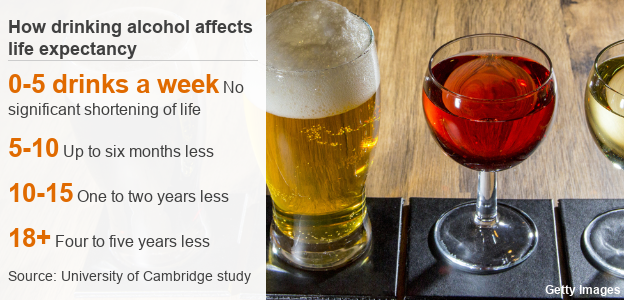
Having as little as one alcoholic drink a day could shorten your life, according to a major new study.
An
analysis of 600,000 drinkers found that drinking five to 10 alcoholic
drinks a week was likely to shorten a person's life by up to six months.
This increases with higher alcohol consumption, with those who have 18 drinks or more losing up to five years of life.
Scientists, who compared the health and drinking habits of
alcohol drinkers in 19 countries, calculated how much life a person
could expect to lose if they drank the same way for the rest of their
lives from the age of 40.